


Does your business struggle because team chemistry breaks down under pressure?
From a team performance coaching and Birkman Method perspective, the gap typically isn’t capability; it’s misalignment between what individuals need from their environment and how teams are structured to operate. Because needs drive behavior, even high-performing teams can quietly fracture beneath the surface.
I’ve seen this happen at multiple employers. In one company, the department leader wanted to manage everyone individually via one-on-one meetings. The team worked somewhat well together, but there were no “team meetings,” and I struggled to understand that approach. When I say no team meetings, I mean I worked there for a year and can remember only one time when our entire department met as a group. While I do understand that some people don’t like meetings and prefer individual communication over group communication, as a leader, you have to hold some full-team meetings to ensure everyone is aligned and working together well. Seal Team Six doesn’t have individual meetings with their leaders before they bust down the door of a bad guy. They talk about the goal, the plan to execute it, and the tasks to succeed. Without those team meetings, people would likely be lost on who is going to do what when executing the plan, and that means people die. Luckily, in corporate America, lives are not on the line.
At Career Upside, we see teams struggle with unmet needs, but they don’t even realize it. When leaders understand the psychological drivers behind behavior, they can build systems that not only perform but also sustain performance using non-judgmental language.
Here are the critical components that define truly effective high-performing team training programs.
1. Uncovering Destructive In-Fights Which Bleed Team Focus Without Leadership Seeing It
Most team dysfunction is subtle. Passive resistance, unspoken frustration, and quiet misalignment often go undetected until performance declines.
Through a Birkman lens, these conflicts are rarely about the work itself. They stem from unmet needs such as lack of recognition, unclear expectations, or insufficient autonomy. When those needs aren’t addressed, individuals shift into stress behaviors that create friction.
An effective, high-performing team training program teaches leaders how to identify these hidden dynamics early. Instead of reacting to outcomes, they learn to diagnose root causes, preserving focus and momentum before conflict escalates.
2. Teaching Direct Operational Conflict Protocols Over Toxic Agreeability Frameworks
Many organizations unintentionally reward agreeability over effectiveness. While this may reduce short-term tension, it creates long-term dysfunction.
High-performing teams operationalize conflict and learn to manage it.
Training must replace vague “collaboration” ideals with clear, repeatable conflict protocols. This means defining how decisions are challenged, how feedback is delivered, and how disagreements are resolved in real time.
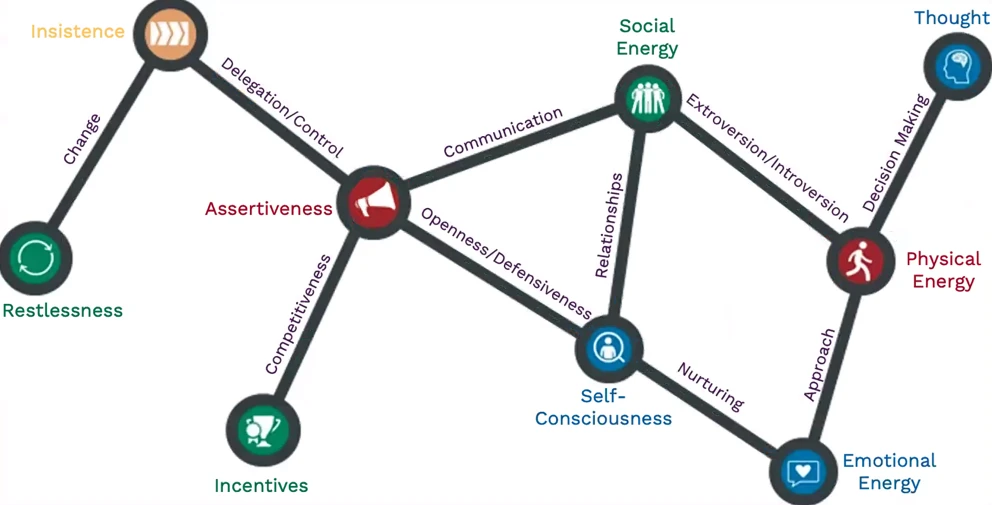
From a Birkman standpoint, this is critical because individuals have different needs around communication and confrontation. When those needs are respected within a structured system, conflict becomes productive rather than personal. I love this image from Birkman that shows how the various Birkman components interact to drive team dynamics. Now, don’t take this literally, but just because there is no line between two of the Birkman components doesn’t mean there aren’t other psychological forces at work; it just paints an interesting picture of team dynamics.
3. Instituting Bulletproof Ownership Strategies Under Remote Circumstances
Remote and hybrid environments amplify ambiguity. Without clear ownership, accountability diffuses quickly.
The most effective, high-performing team training programs establish non-negotiable ownership frameworks. Every deliverable, decision, and outcome must have a clearly defined owner with no gray areas.
This is where behavioral insight becomes powerful. Some individuals naturally assume ownership, while others require a clearer structure to feel confident stepping in. By aligning responsibilities with behavioral tendencies and underlying needs, leaders create systems that hold under pressure. Without this, team members may be resistant to taking the lead on projects and action items.
4. Transitioning Fast-Recovering Crisis Cultures Back into Steady Workflow Engines
Some teams excel in crisis mode. They move fast, collaborate intensely, and deliver results under pressure. But over time, this creates burnout and instability.
High-performing team programs must address the transition from reactive excellence to sustainable execution.
Birkman insights are especially valuable here. In a crisis, certain needs, such as the need for urgency and action, are temporarily met. But in steady-state operations, other needs, such as structure, predictability, and balance, become critical. Without recalibrating to meet those needs, teams remain stuck in a reactive loop.
Effective team building equips leaders to stabilize performance, creating workflows that maintain energy, clarity, and consistency without relying on constant urgency.
Request a Consultation for Team Training With Career Upside
High-performing teams aren’t built on talent alone. They’re built on alignment. When leaders understand that needs drive behavior, they stop managing symptoms and start designing environments where performance becomes the natural outcome. Leaders who don’t do this may need to find a new department or environment for certain employees. Isn’t it funny how an employee can thrive on one team and struggle on another? If people are leaving your team and finding success, then perhaps looking at the environment you are creating for success can help you determine your next steps.
I have lived in Atlanta for 46 years, where competition is high, and expectations are higher; this level of intentionality is a differentiator. At Career Upside, we believe the future of leadership isn’t just strategic. It’s behavioral. And the teams that win will be the ones trained to operate accordingly. If you need help building or aligning your team, schedule a consultation.